Stable Midwest Farmland in an Unstable World
__primary.png?v=1785956443)
With all the uncertainty in the world and markets right now, Midwestern farmland gives people a feeling of stability, says Doug Hensley, president of Hertz Real Estate Services. “I don’t want to be overly optimistic. But I think there is some upside potential to the farmland market between now and the end of the year,” he adds. “It’s not a traditional “Seller’s market”, but it sure seems seller-friendly.”
Yet from a production agriculture perspective, that might not make sense, Hensley admits. Profit margins for crop farmers are extremely tight right now. Countering that, however, is the fact that “row-crop and recreational land is held in strong hands,” explains Hensley. “So, there just isn’t much land for sale, nor is there a reason for much land to come to market – and both of those things are price supportive.”
Other revenue sources for farmers have also helped maintain farmland values such as government farm program payments, enhanced crop insurance support, and the growth in wind, solar, and other commercial developments across the Midwest.
As summer matures towards fall, Hensley also mentioned four factors to watch that will influence buyer attitudes for Q3 and Q4 land sales:
1. Weather
The crop got off to a good start this spring with timely planting and adequate moisture. Looking ahead, how the crop progresses throughout the rest of the growing season will affect how confident farm buyers will be heading into the fall.
2. China
China matters because of the sheer size of its potential demand for our crop exports, Hensley explains. China has pledged to buy at least 25 million metric tons (MMT) of U.S. soybeans annually through 2028 (up from 18 MMT in 2025). And, after the May summit between Donald Trump and Xi Jinping, China also pledged to buy $17 billion annually in U.S. farm goods (in addition to soybeans), which market watchers say would require significant corn purchases to meet. This compares to China’s imports of just $8.4 billion of U.S. agricultural goods last year, but down from China’s peak purchases of $38 billion in U.S. farm goods in 2022.
3. Iran
“Our conflict with Iran has affected oil, fuel and fertilizer prices around the world, and indirectly our inflation rate,” Hensley explains. As Middle East negotiations continue, the situation remains in flux, as does the long-term market reaction.
4. Interest rates
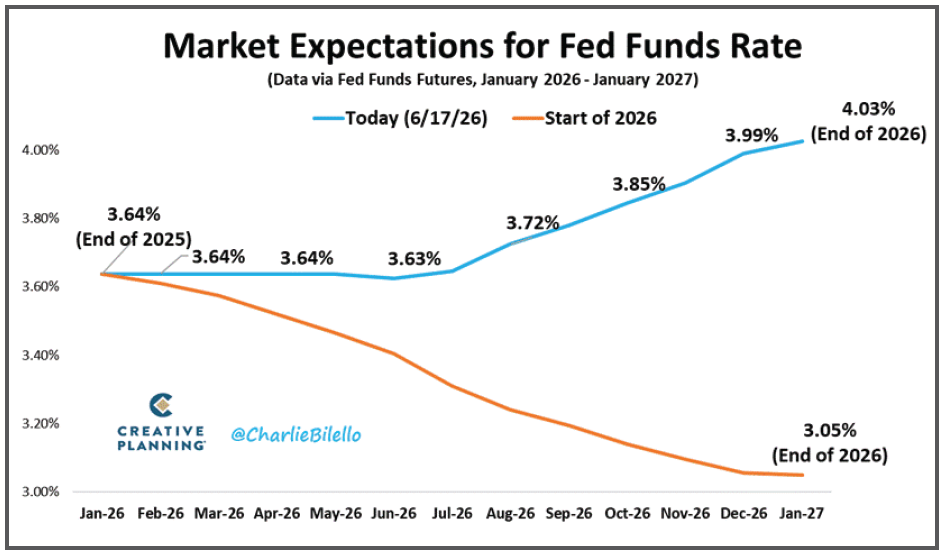
The new Federal Reserve chairman, Kevin Warsh, may have had a bent toward lower interest rates. But because of the geopolitical realities with Iran and higher oil, inflation has spiked again, along with a bump in long-term interest rates. “Because of this inflation flare up, it’s widely expected that the Fed will reverse their 2025 course of lowering short-term rates and move to increase them before year-end 2026,” Hensley explains.
“If we see interest rates move meaningfully higher, we may see some additional pressure on the economy and asset values, including farmland,” he concludes.
For farm owner-operators, who built up working capital in profitable years from 2021-23 and have a strong collateral base, simply having stable land values is good news. “In production ag, the folks feeling the most pressure with these slim to negative farm operating margins are those who rent all or most of their land,” says Hensley. “While many expected rents to tick down this year, for the most part, they were flat for 2026. And while input prices jumped following the start of the conflict with Iran, most operations were fortunate to already have had 2026 inputs booked. We’ll see what happens with input pricing this fall, going into the ’27 crop year.”
Hensley recognizes the financial strain for farming businesses, but estimates only a small minority of Midwest farmers are in a financially precarious situation. For some, off-farm incomes are helping to balance on-farm weaknesses. And, there are some operations that are using sale-leasebacks to take advantage of the strong land market to provide a capital cushion.
A final factor affecting farmland values in some locations is the proliferation of data centers (see accompanying article). “Capital gains deferrals on data center land sales are real. The per acre price for data center land is often north of $100k per acre, and many of these projects total multiple millions of dollars. Reinvestment of data center land sale funds through 1031 tax-deferred exchanges is impacting the farmland market,” Hensley notes.
“And it’s happening across the Midwest in places around Des Moines, Omaha, Chicago, and Indianapolis – as well as many rural areas in-between. Data centers are providing an upside bias in land values in areas wherever they are being built,” advises Hensley.
Uncertainty is the way of life in agriculture, with dependence on weather and world trade for a significant part of its demand. “We continue to deal with the cyclical nature of agriculture. Beyond the normal cycles, current uncertainty seems to be moving a mile-a-minute, and many people feel unsettled. Fortunately, farmland is a stabilizing, long-term asset,” concludes Hensley.
Stay Connected and Informed
Agriculture and market conditions are constantly shifting. Subscribe to receive our monthly market updates and expert insights, so you’re equipped to make confident, well-timed decisions. If you have questions about your land, our farmland experts are ready to help.
Related Articles