
Saturated Buffers: A Practical Way to Impact Water Quality

By: Hertz Stewardship Committee
Iowa water quality continues to command attention in news coverage and policy discussion. At Hertz, that attention reinforces the importance of helping clients identify practical conservation measures that meet their goals, fit their farms, and can make a real impact.
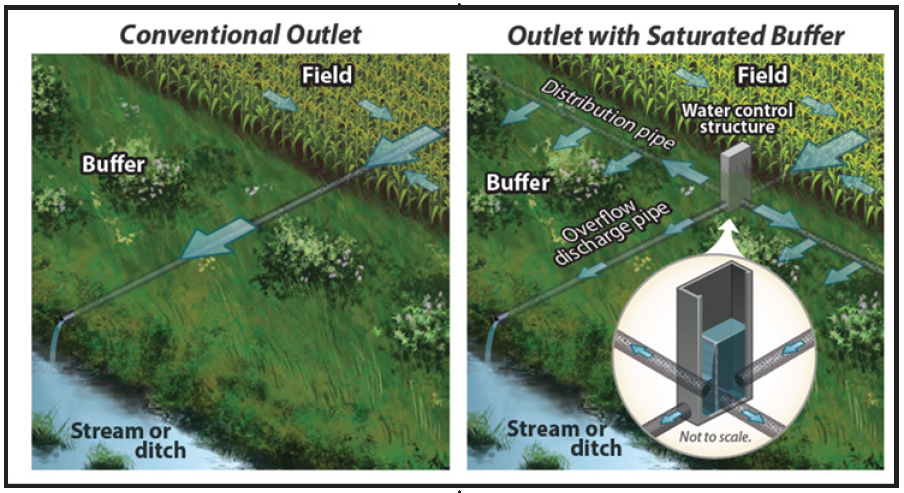
One recent example is the implementation of a saturated buffer on a managed farm in Marshall County, Iowa. Saturated buffers redirect tile drainage water through the soil beneath perennial vegetation, where natural processes help extract nitrates before the water reaches nearby streams or ditches. This practice has shown to reduce annual nitrate load from drainage tile by 40-60%. Saturated buffers require little to no active maintenance and are expected to last for decades.
The project included installing four control structures treating drainage from six tile mains. In two locations, pairs of tile mains were connected and combined into a single control structure. The control structures distribute the water laterally into a grass filter strip. The design allows water from multiple parts of the farm to be treated efficiently while minimizing disruption to the farming operation and existing tile system.
In addition, 7.2 acres along a stream were enrolled in Conservation Reserve Program (CRP) filter strips. These perennial areas complement the saturated buffer system and provide another layer of protection for water resources in a sensitive area.
Source: Iowa State University Extension and Outreach
For the landowners, the opportunity delivered both conservation and financial value. Thanks to investments from the local watershed, project costs were covered, and they received an incentive payment for each tile line treated. The CRP filter strips were enrolled at a payment rate close to what the land would otherwise generate in cash rent.
At first, the landowners were understandably skeptical. When explained that the costs would be covered and an additional payment would be provided, their reaction was essentially, “What am I missing?” After the paperwork was completed and they confirmed there was no hidden catch, they viewed the project as a “slam dunk” opportunity.
The project would not have been possible without a partnership with Heartland Cooperative’s Conservation Agronomy team. Hertz and Heartland Cooperative worked together to identify sites within priority watersheds that were ideal for implementing saturated buffers and bioreactors at no cost to the landowner. The team at Heartland took care of all the fine details – surveying, project bidding, paperwork, and more. This led to multiple projects being completed across several different watersheds.
These practices are not a complete answer by themselves, but they are proven, site-specific tools that can contribute to broader nutrient-reduction efforts. This project illustrates how proactive farm management can connect landowners with programs that make meaningful conservation improvements available and financially workable. The result is a conservation practice that benefits the farm, supports the owners’ goals, and can make a positive local impact on one of Iowa agriculture’s most visible challenges.
Stay Connected and Informed
Agriculture and market conditions are constantly shifting. Subscribe to receive our monthly market updates and expert insights, so you’re equipped to make confident, well-timed decisions. If you have questions about your land, our farmland experts are ready to help.
Related Articles
Why Iowa Water Quality Profress Looks Different Than We Expected
Stewardship in Action: A New Landowner's Journey