
Grain Markets - Summer 2026
__primary.png?v=1782396834)
Another planting season has arrived in the United States and the uncertainty impacting the commodity markets seems elevated compared to most years due to conflict in the Middle East.
Every crop growing season begins with expectations for total production and grain prices. Price expectations are based on forecasted carryover supplies from the previous year, the outlook for summer weather, and the USDA projections for supply and demand for the current year. Most years, factors change and the outlook can vary greatly throughout the season. Weather and crop development can vary, and the USDA’s supply and demand forecast can change. Some years, there can be substantial variation from the USDA’s early season production and demand forecast to the actual results after harvest. That was the case for the 2025 crop year.
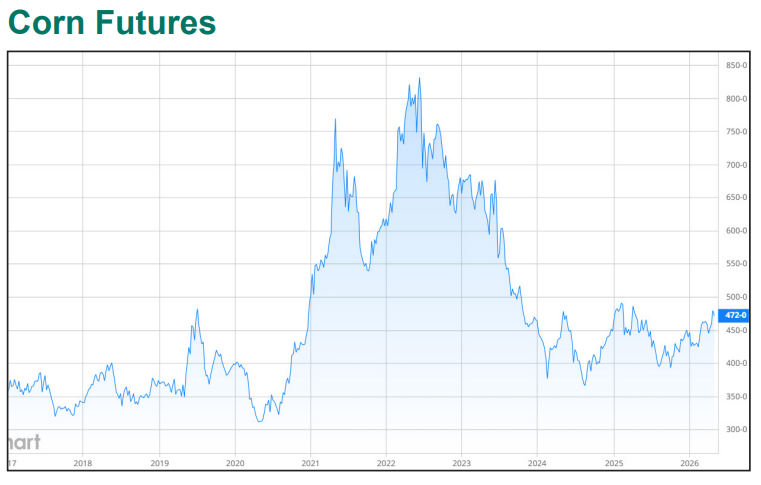
USDA released the Annual Crop Summary in January 2026, and the production numbers for 2025 came in much higher than anyone expected for both the corn harvested acreage and yield. The report showed U.S. corn planted acreage of 98.8 million acres, harvested acreage of 91.3 million acres, and a record corn yield of 186.5 bushels per acre. We produced the largest corn crop in history at over 17.0 billion bushels. The ending carryout ballooned to 2.2 billion bushels. In comparison, the initial USDA report for the 2025 crop year released in May 2025 showed 95.3 million planted acreage, 87.4 million harvested acres, and a yield of 181.0 bushels per acre. The projected crop production totaled 15.8 billion bushels and ending carryout was expected to be 1.8 billion bushels.
The January 2026 report was also negative for soybeans. While USDA didn’t show substantial increases in soybean acreage or yield from previous reports, ending stocks increased from 290 million bushels to 350 million bushels. Compared to the May 2025 USDA report, both planted and harvested soybean acreage were 2.3 million acres less in the final report. This decrease was understandable considering the large increase in corn acreage that occurred in 2025. Demand is another factor that can change throughout the marketing year. The corn market has been supported by very strong exports and domestic demand. Corn exports have been robust for the 2025 marketing year and are well into new record territory. The previous record for corn exports was last year, and the current export pace is running 30% ahead of 2024! Total corn use for the 2025 crop year is forecast to be 16.47 billion bushels. If achieved, total corn demand will be 1.0 billion bushels larger than the initial USDA forecast in May 2025.
Soybean demand has been softer than USDA expected in their early 2025 projections. Domestic demand for soybeans has been excellent, running 12% higher than the previous year. However, soybean exports have been lagging behind the expected pace. China is the leading soybean importer in the world, but their purchases from the US have been limited. Soybean prices have been supported by renewed optimism that China will follow through on additional soybean purchases for the 2026 marketing year.
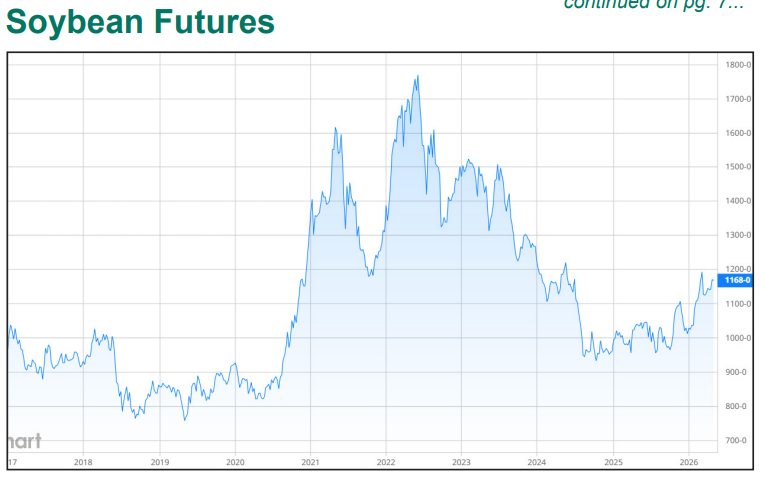
Commodity prices have rallied since the start of the Iran war. But higher energy prices significantly increase production costs across the agricultural sector. Because natural gas is a primary feedstock for nitrogen-based fertilizers, disruptions in energy markets directly drive-up costs for fertilizer. High fertilizer prices may lead to a shift away from corn acreage in 2026 if producers didn’t lock in fertilizer prices prior to the start of the war. Weather conditions during planting season may also lead to acreage shifts from producers’ original planting intentions.
The challenge for the 2026 marketing year will be to anticipate what changes may occur to the USDA balance sheets as the growing season progresses. There were significant shifts in acreage, corn yield, and demand during the 2025 crop year. From a marketing standpoint, it will be important to develop a marketing plan and remain disciplined to make sales as the grain markets present opportunities on rallies. Hertz Farm Management’s grain marketing philosophy is based on a consistent and disciplined approach of decision making to remove emotion during market swings which will be advantageous in 2026.
Stay Connected and Informed
Agriculture and market conditions are constantly shifting. Subscribe to receive our monthly market updates and expert insights, so you’re equipped to make confident, well-timed decisions. If you have questions about your land, our farmland experts are ready to help.